A calmer way to join yarn and finish loose ends
Practice a simple same-color join, understand where color changes happen and weave tails without pulling your crochet out of shape.
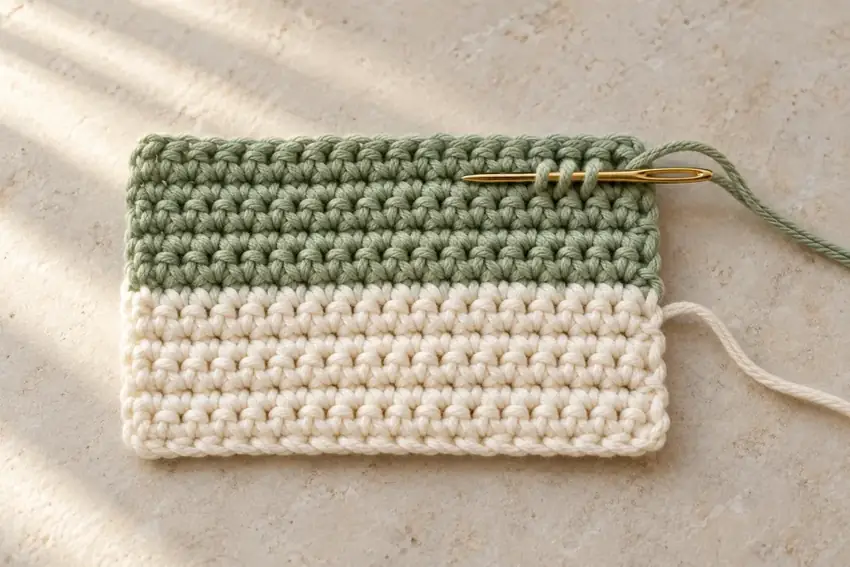
Plan the join before the yarn runs out
A join adds a new strand of working yarn; weaving in secures and hides the tails afterward. Treat them as related steps rather than expecting the moment of joining to finish everything. For plain practice fabric, an edge join is often easier to inspect and conceal than a join placed in the middle of a visible area.
Pause while there is still enough old yarn to work comfortably and leave a usable tail. Keep the new yarn's label beside the old one, especially if matching dye lots matters. Do not assume two yarns with the same color name are identical in shade, thickness or fiber.
Try one clear join in single crochet
Practice on a scrap swatch first. Work the final single crochet of a row until two loops remain on the hook: insert the hook, yarn over with the old yarn and pull up a loop. Now lay the new yarn over the hook and draw it through both loops. The stitch is completed with the new strand, which is ready for the next row.
Leave both old and new tails hanging with enough length to thread a yarn needle and make several weaving passes. Hold the tails lightly while you chain and work the first few stitches with the new yarn. Adjust the join so it sits at a similar tension to its neighbors, without pulling it into a tight dimple.
This is one conventional method, not the only valid join. Specialty yarns and particular designs can need a different approach. A new-ball join in the same color is a useful place to learn before tackling a visible color chart.
Understand why a color change can happen early
For this single-crochet method, the final pull-through places the new color on the hook before the next stitch begins. If you complete the old stitch fully and only change yarn afterward, you may place the transition differently from the pattern's intended position. Follow the design's stated color-change instructions.
For other stitches, identify the final pull-through for that stitch rather than assuming every change starts with two loops on the hook. Half double crochet, for example, normally closes three loops together. Practice one change on a sample and inspect both sides before committing to many repeats. These learning notes are not a maker-tested colorwork project.
Fasten off the final live loop
At the end of a piece, cut the working yarn with enough tail left for weaving. Draw the cut tail all the way through the final live loop and snug it gently. This closes the active loop, but the tail still needs securing through the fabric. Pulling extremely hard can distort the edge rather than make it safer.
Keep fastening off distinct from joining a new ball: when you use the join above, the new working yarn continues the fabric. You do not fasten off and restart simply because two strands met. Read ahead before cutting if the pattern asks you to leave a sewing tail for assembly.
Weave through the fabric, not across open spaces
Thread one tail through a blunt yarn needle. On the less visible side, guide it through the backs of neighboring stitches where the yarn can be supported and concealed. Follow the fabric's structure, avoiding large exposed floats. Change direction for another pass where the fabric allows, without simply retracing an identical empty channel.
Pull only enough to settle the tail. Lay the fabric flat and gently flex it; the surrounding stitches should keep their normal spacing. If the area puckers, loosen the woven strand before trimming. Work the other tail separately, and inspect the visible side so the join does not introduce an unexpected line or lump.
There is no single tail length or number of passes that guarantees security in every yarn. Smooth, slippery fibers, open stitches and items washed frequently can need a different route from a dense, grippy fabric. Crocheting over a tail can help hold it temporarily, but do not assume that alone will secure every yarn for its intended use.
Check before you trim
Examine the join from both sides and gently stretch the swatch as it will move in use. Test the planned care method on a sample before relying on a new finishing technique. Keep enough tail available to improve the join if the strand shifts. A knot with clipped-short ends is not a universal substitute for secure finishing.
Record what worked for the specific yarn and stitch. A note such as 'tail visible on front after washing' points to a useful adjustment next time. Finishing becomes much less mysterious when you can compare a few small samples instead of experimenting for the first time on a completed blanket.