Project overview
- Skill level
- Easy · US terminology
- Finished size
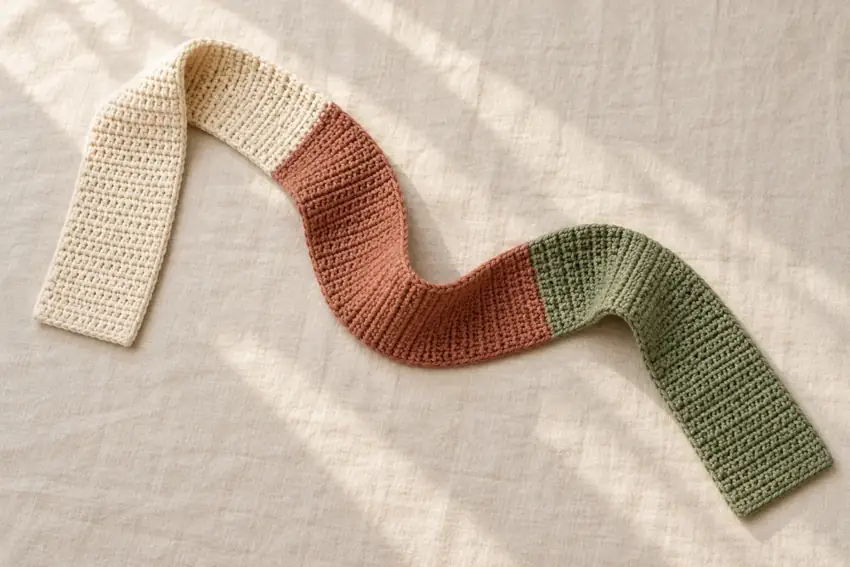
- Target approximately 8 × 60 in (20.3 × 152.4 cm), from 28 stitches across and 150 rows at target gauge. Each color block is approximately 20 in (50.8 cm) long.
- Gauge
- Target: 14 half double crochets and 10 rows = 4 in (10.16 cm), measured through an interior area of a washed, relaxed swatch.
- Testing status
- Written draft — maker testing pending
Materials & tools
- Soft category 4 / medium-weight yarn in cream (A), terracotta (B) and sage (C), preferably the same yarn range and fiber blend. Set aside about 220 yd (201 m) of each color, including swatching allowance. This is a planning estimate, not measured consumption.
- A 5.5 mm hook as a starting point, or the size giving the target gauge and a comfortable drape.
- Two removable markers, blunt yarn needle, scissors, ruler or tape measure and the yarn care labels.
Abbreviations & stitch notes
- US terminology throughout.
- ch = chain
- hdc = half double crochet
- st / sts = stitch / stitches
- yo = yarn over
For a refresher, use our chain and single crochet lesson, double crochet lesson, or US / UK terminology referenceCalculate stitches from your gauge →.
Let's make it, step by step.
Read the full pattern once before starting. Optional checkboxes help you follow the sequence for this page view only.
- 28 hdc
With cream A, chain 29. Half double crochet in the second chain from the hook and every remaining chain. The skipped chain does not count. Mark the first and last half double crochets.
- 28 hdc on every row; 49 cream rows so far
Chain 1 and turn; the chain does not count. Half double crochet into both top loops of the first stitch and every stitch across, including the last marked stitch. Move the markers. Repeat this row until 49 cream rows are complete.
- 50 cream rows; 28 hdc in row 50
Work row 50 using the same edge rule. On its final half double crochet, use cream through drawing up the loop; with three loops on the hook, use terracotta B for the final yarn-over and pull through all three loops. Cut cream with a weaving tail.
- 50 terracotta rows; 100 rows total
Chain 1 in terracotta and turn. Work 28 half double crochets across for each row, using the same non-counting turning chain. Complete fifty terracotta rows: rows 51–100 of the scarf. On the last half double crochet of row 100, switch to sage C for the final pull-through, just as at the previous change. Cut terracotta with a weaving tail.
- 50 sage rows; 150 rows total
Chain 1 in sage and turn. Work the same 28-stitch half-double-crochet row fifty times, giving rows 101–150 of the scarf. Count all three blocks: each contains fifty rows. Do not add a turning chain after the last row.
Cut sage with a generous tail and pull it fully through the live loop. Weave every tail through neighboring matching-color stitches, changing direction without cinching the edges. Check color-change joins from both sides. No edging or fringe is added.
Wash and dry following the yarn label, lay the scarf relaxed and measure the width, each block length and the total length. Record actual yarn use and any difference from the target gauge before making another size.
Construction, finishing & helpful notes
Three equal blocks make the whole design
Work fifty rows in cream, fifty in terracotta and fifty in sage, in that order along the scarf's length. There are no stripes within a block, no fringe and no separate border. The result is a plain rectangle whose visual rhythm comes from its three broad fields of color.
This is a written draft rather than a tested garment sample. The dimensions come from the target gauge. Choose a yarn that feels pleasant against your neck, and assess its washed swatch for drape before making a long piece.
One stitch, one edge rule
To make a half double crochet, yarn over, insert the hook under both top loops of the indicated stitch, yarn over and draw up a loop, then yarn over and pull through all three loops on the hook. End with one live loop.
This recipe uses chain 1 for turning, and that chain does not count as a stitch. Work the first half double crochet into the first stitch immediately below the chain. Mark both end stitches and stop at the last marked stitch; do not work into the old turning chain. Keep those rules through every color change.
Plan the size and yarn together
At fourteen stitches per four inches, twenty-eight stitches give eight inches. At ten rows per four inches, fifty rows give twenty inches per block and 150 rows give sixty inches total. A different row gauge changes both total length and the block proportions unless you adjust each block equally.
For a different scarf width, choose W half double crochets and chain W + 1. For a different length, choose the same whole number of rows for each of the three blocks. A sixty-row total divided into three twenty-row blocks, for example, is a different shorter design and needs its own measured gauge; do not assume that changing the row count preserves a particular fit.
Change colors without a knot in the edge
On the final half double crochet of the last row in a block, use the old color through drawing up the loop, leaving three loops on the hook. Use the new color for the final yarn-over and pull through all three loops. The completed stitch belongs to the old-color row; the new loop is ready for the next row's turning chain.
Cut the old color with a generous tail; do not carry it across a twenty-inch block. Support both tails while making the first few stitches in the new color. Weave them later into matching-color stitches without pulling an edge inward. A small initial gap at the join is usually easier to correct with careful weaving than by a hard knot.
Check straight edges and equal sections
Count twenty-eight stitches after the first few rows and after every color transition. If a block widens at its first row, check for a half double crochet accidentally worked into the turning chain. A narrowed block often comes from overlooking the last marked stitch.
Lay the scarf down periodically without stretching it. All three colors should behave similarly, but some dye colors can feel different even within the same yarn range. Compare block lengths, record the row count and reassess tension before adding the next block. Care for the completed scarf according to its yarn label and measure again after drying.
Video help for the techniques
These external tutorials explain stitches or finishing used in this recipe. Follow this page for the project's exact counts, placement and assembly.
How to Half Double Crochet (HDC) — Yarnspirations / Red Heart Design Team ↗Weave In Ends in Crochet — Yarnspirations ↗Browse all technique references →Explore the Beyond the Basics collection →
Keep your next make a little easier.
Save yarn, hook, gauge and measurement notes using our free starter checklist.
Open the free checklist ↗